
Multimedia · v1.18.2
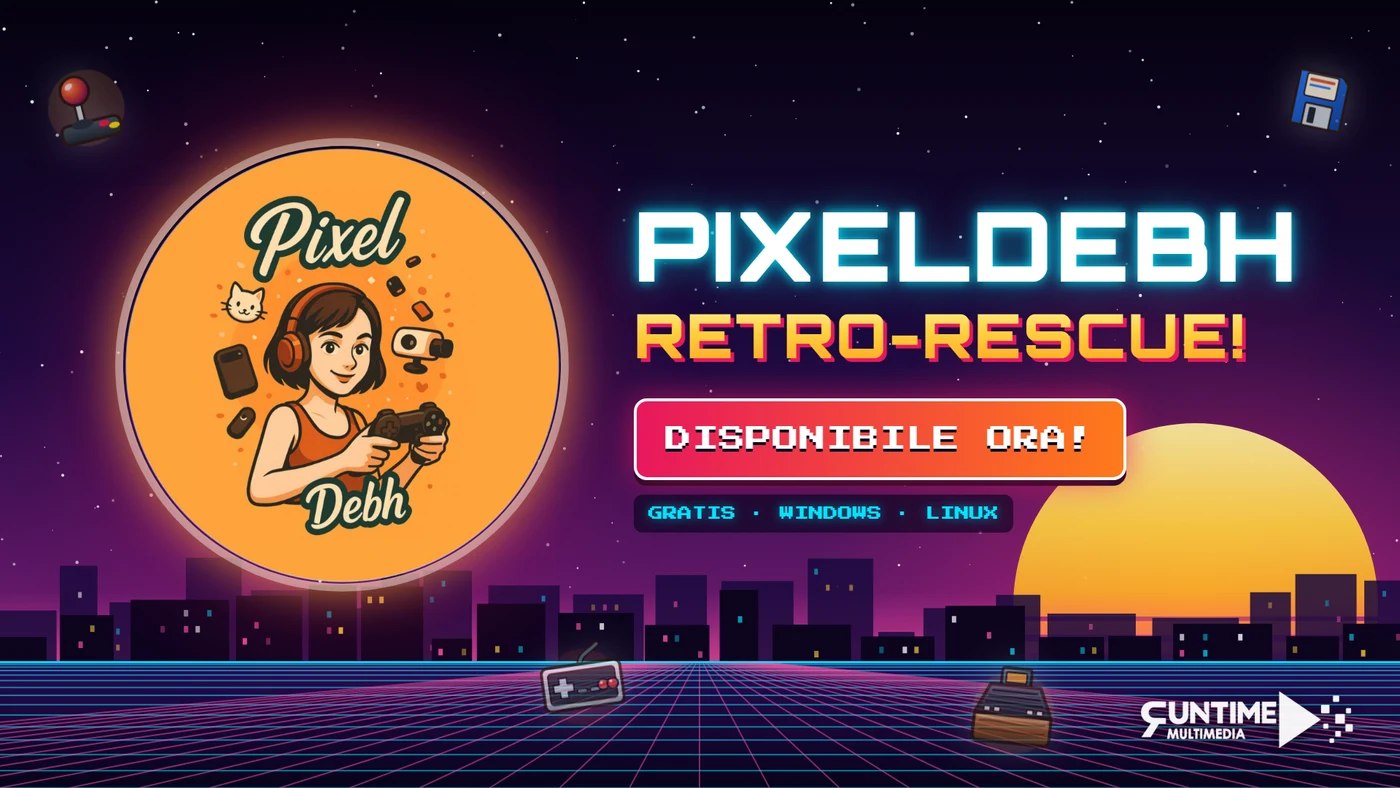
PixelDebh: Retro-Rescue!
A retro arcade platformer: capture enemies, throw them back, collect the consoles and beat three bosses.
What it is
Debh has an unusual weapon: she grabs enemies and throws them at the others. Fourteen levels across three worlds, three bosses, a labyrinth and a vault of collectible consoles where it all ends. Free, for Windows and Linux.
You capture, you throw, you jump twice. Every level asks you to collect all the collectibles, from joysticks and floppy disks to cartridges and consoles, before the door at the far end opens; meanwhile five kinds of enemies have to be kept at a distance or used as projectiles.
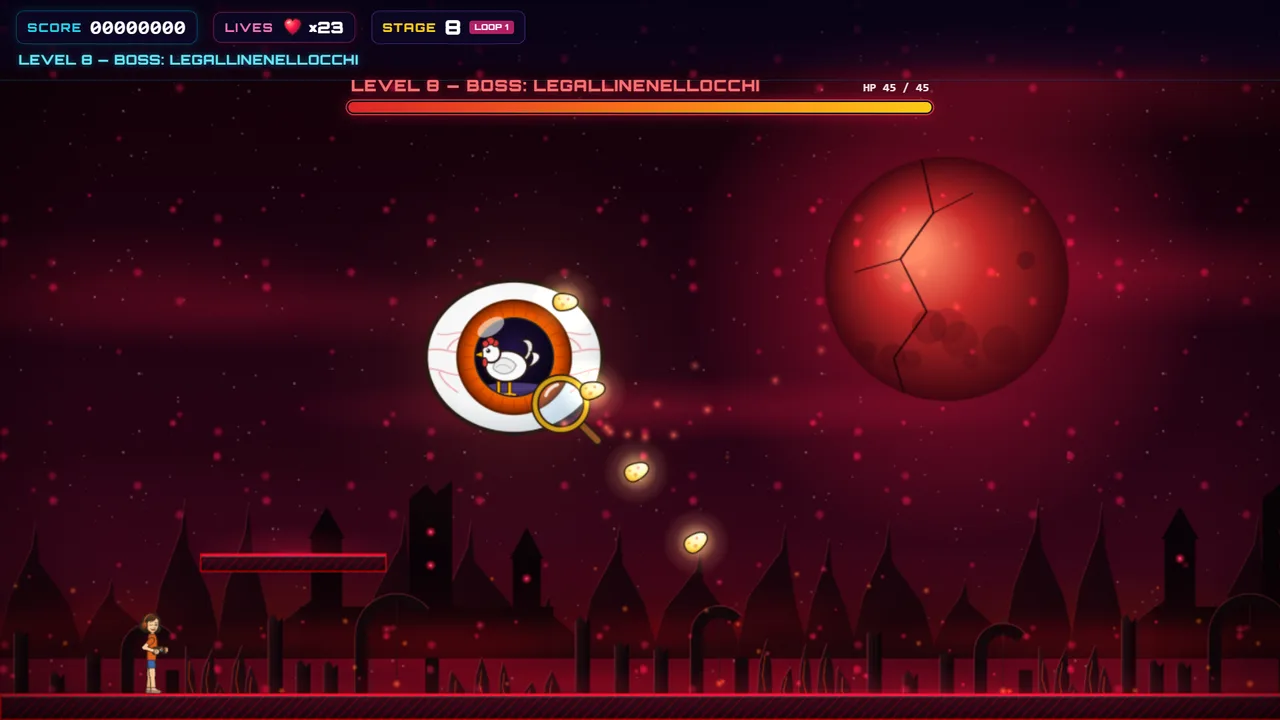
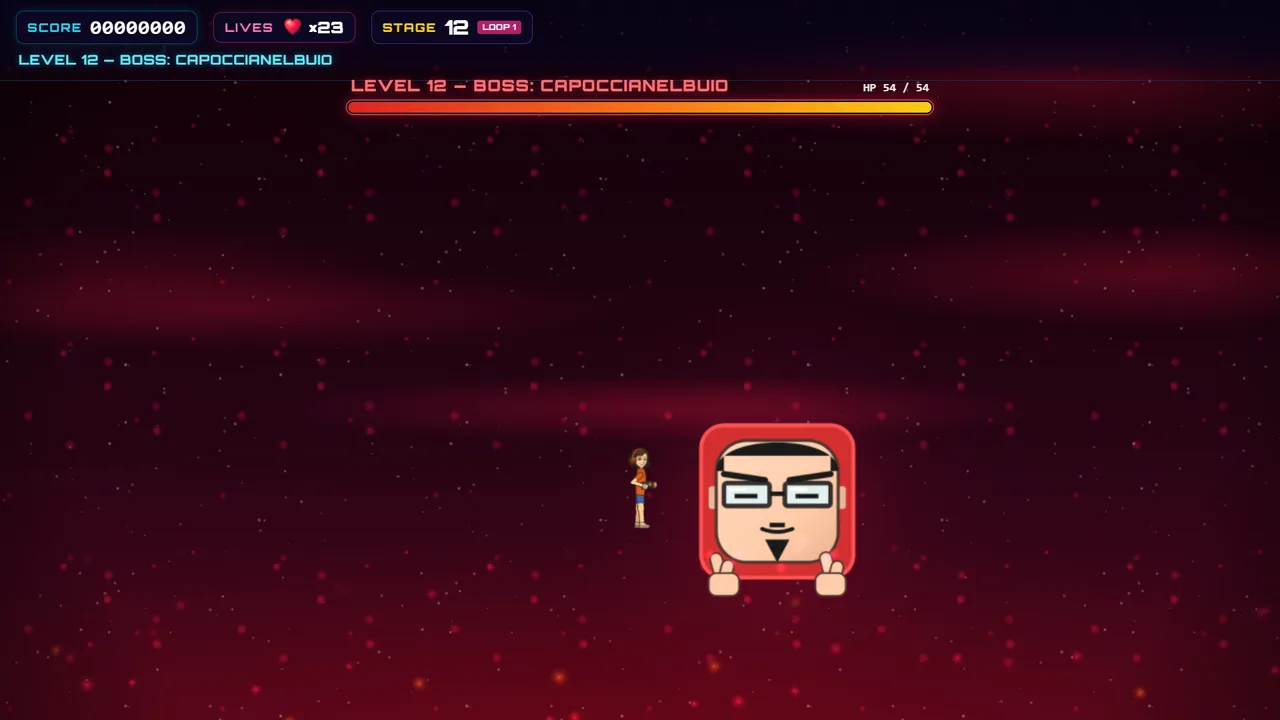
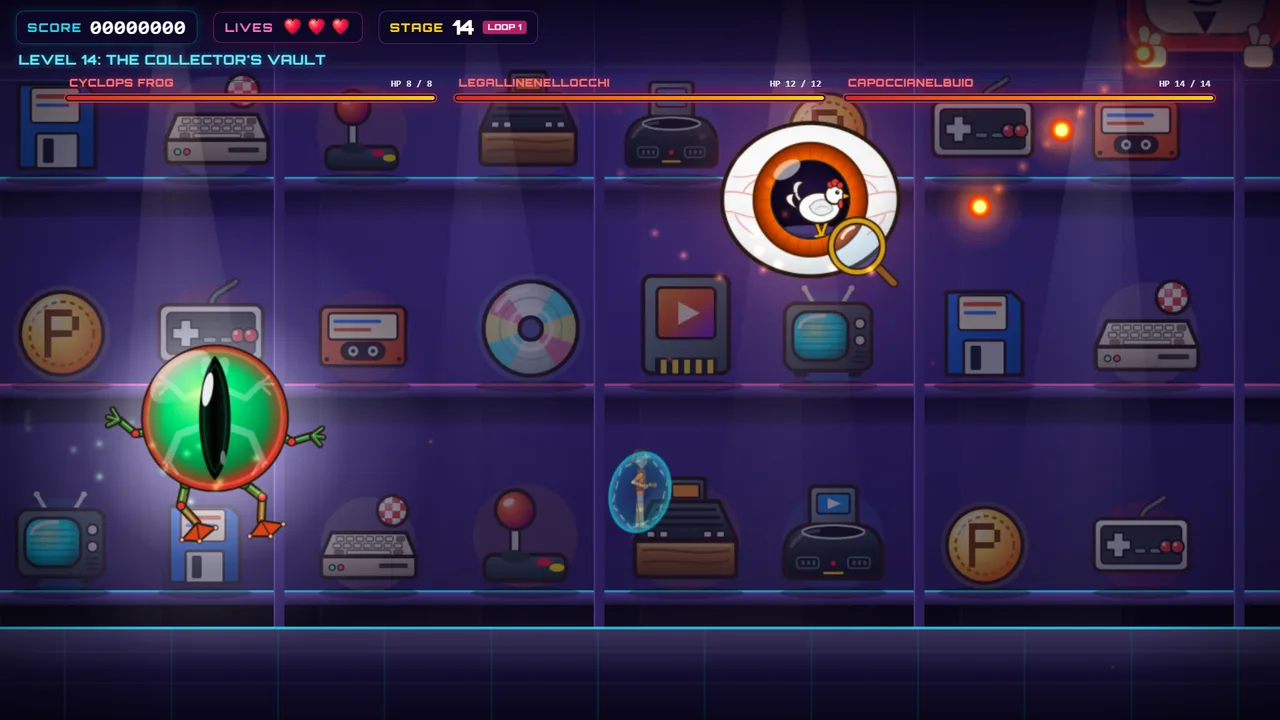
Three bosses, one per world: a cyclops frog, an eye with a chicken for a pupil, and CapocciaNelBuio. After the labyrinth, in the spirit of the Atari 2600, you reach the collector’s vault, where the three bosses wait together.
Features
- 01
Capture enemies and throw them at the others
- 02
Fourteen levels: three worlds, three bosses, a labyrinth and a final showdown
- 03
Retro-gaming collectibles, from the Atari 2600 to the Amiga 500
- 04
Twenty-two trophies and an arcade-style leaderboard
- 05
Three difficulty levels, saves and a level select
- 06
Gamepad, remappable keys, Italian and English
- 07
Free, for Windows and Linux, with automatic updates
- 08
Open source code, high-definition vector graphics
Screenshots
01 / 09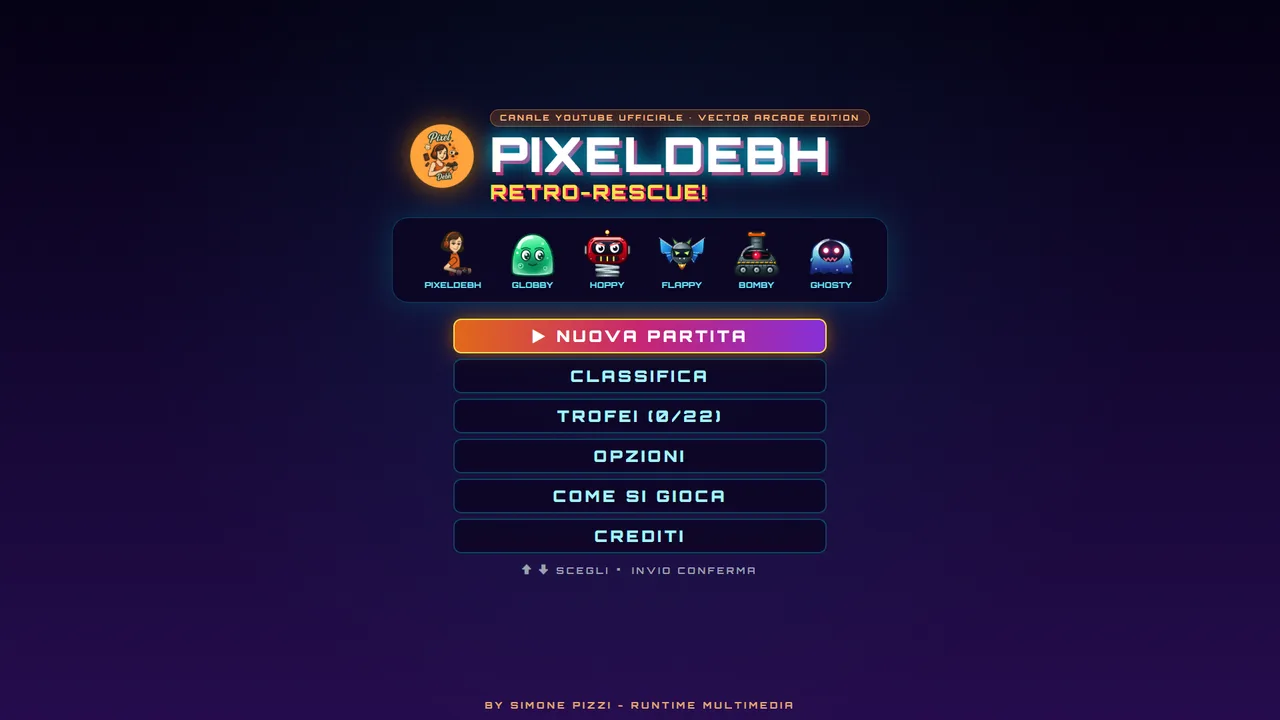


They scroll on their own. Click an image to enlarge it.
How to play
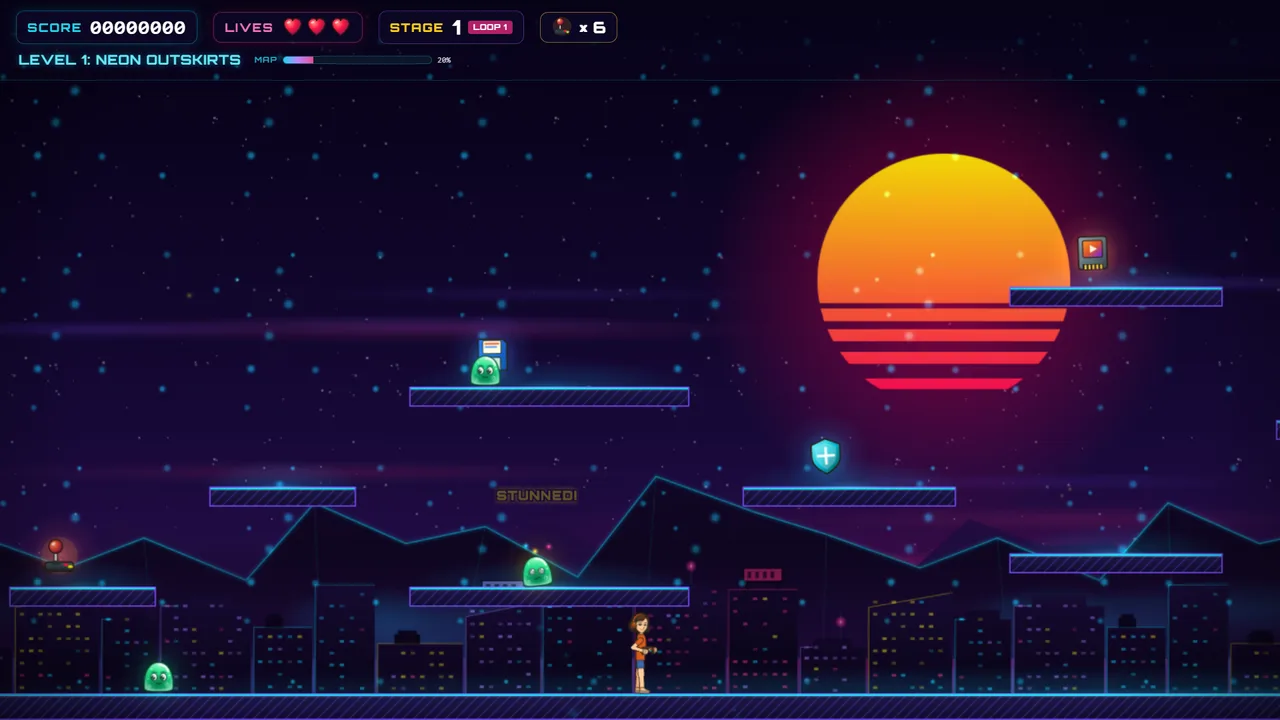
Get close to an enemy and press the capture key: you are holding it. Press it again and you throw it in the direction you are facing, at the others. The double jump reaches the high platforms, and hitting a platform from below stuns the enemies walking on top of it.
Defeats that follow each other within four seconds build a chain that raises the score multiplier up to ×5. In boss fights you shoot in eight directions; below half its life, and again below a quarter, a boss attacks faster and a banner says “PHASE”. Enemies give notice before they attack too: Hoppy crouches, Bomby swells.
- A · D · ← →
- Walk.
- Spazio
- Jump. Pressed again in mid-air, a double jump.
- C · X
- Grabs an enemy; with an enemy in hand, throws it.
- Shift sinistro
- Shoots in boss fights and in the zero-gravity levels, in eight directions.
- Esc · M
- Pause (the game also pauses by itself when the window loses focus) · mute.
- F · F11 · Alt+Invio
- Full screen or window.
- Gamepad
- The standard layout (Xbox, PlayStation and most modern pads) works in the menus too. Keys are remapped in Options > Controls.
Worlds, bosses, labyrinth and vault
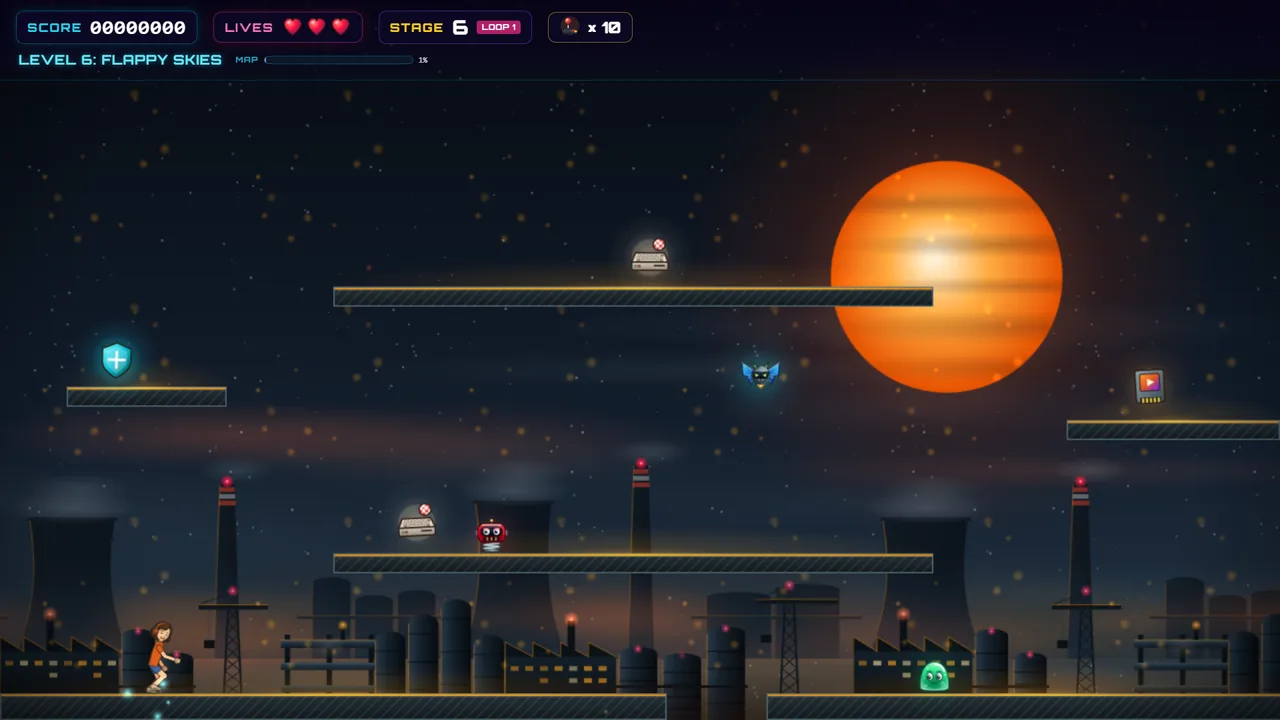
Each world has three levels and a boss, and every level is longer than the one before; enemies arrive one at a time, so you learn them as they come: Globby, Hoppy, Flappy, Bomby and Ghosty.
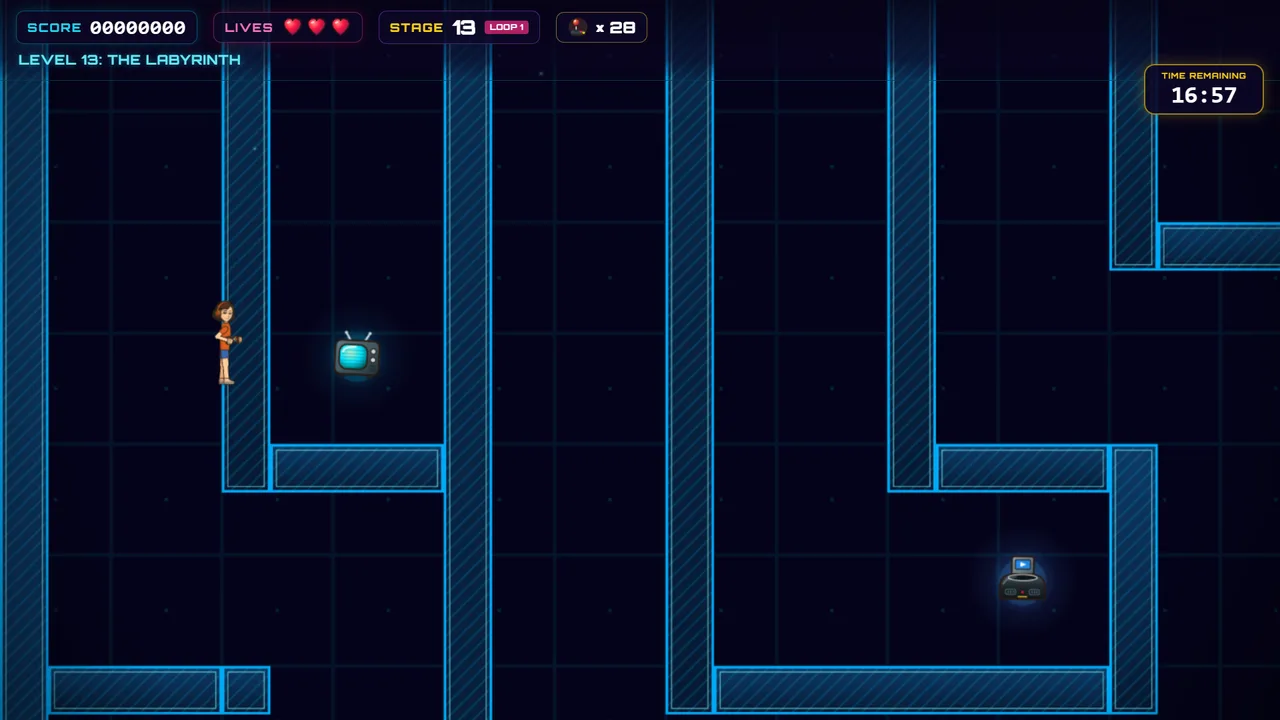
The labyrinth takes after the Atari 2600: corridors on a grid, dead ends and loops, always the same, with the camera close to Debh. To open the exit you must collect every item on the map, dodging the enemies that patrol the corridors, before the time runs out (17 minutes; every LOOP takes a minute off and adds a fifth more enemies).
The exit leads to the collector’s vault, a museum hall whose shelves are full of giant consoles. Here the three bosses wait for you together, each with a quarter of the life it has in its own level. Debh moves freely in every direction, arrives with all her lives and a shield, and the game is won when all three have fallen.
- World 1
- Neon city. Neon Outskirts, Circuit City, Hoppy Hills. Boss: Cyclops Frog (level 4).
- World 2
- Refinery in the smog. Vertical Ventures, Flappy Skies, The Gauntlet. Boss: LeGallineNellOcchi (level 8).
- World 3
- Floating islands and a ringed planet. The Ascent, The Drop, The Phantom Reach. Boss: CapocciaNelBuio (level 12), in zero gravity.
- Level 13
- The Labyrinth.
- Level 14
- The Collector’s Vault, the final showdown.
The collector’s items
Debh is a retro-gaming collector, and every level asks you to gather her haul. At first joysticks, floppy disks and cartridges; then come the cassettes, the arcade tokens, the CRT televisions, an Atari 2600, an Amiga 500, the CD-ROMs, an NES pad and a Mega Drive console: eleven kinds, introduced a few at a time. There are three power-ups too: speed, shield and super throw.
The drawings are original and carry no logos. The names of the consoles and objects belong to their respective owners, and the game has no connection with them.
Trophies, difficulty and saves
- Trophies
- Twenty-two, in four kinds: normal, rare, hard and completion. A banner with a jingle announces each one; the T key opens the list.
- Difficulty
- Easy (5 lives, slower enemies, weaker bosses), Normal, Hard (2 lives, faster enemies, tougher bosses). You choose in Options > Game.
- Leaderboard
- An arcade Hall of Fame: if you make the top five you enter three initials, like on a cabinet. For now it is local, on your own computer.
- Continue
- The game remembers where you were at the start of every level. Levels you have reached can be replayed from the level select, for practice: no leaderboard and no trophies.
- LOOP
- Beat the game and you start a new LOOP: enemies and projectiles 20% faster, score and lives carried over.
- Languages
- Italian and English: the game follows the system language until you pick one.
Download and install
The game is free. The files are in the GitHub releases. The game starts in full screen; F11 switches to a window.
- Windows
- The file ending in “-setup.exe” installs the game, which then updates itself. “PixelDebh-1.18.2-portable.exe” runs without installing and only tells you when a new version is out.
- Linux
- An AppImage that works on any distribution and updates itself, or the .deb (Debian, Ubuntu, Mint) and .rpm (Fedora, openSUSE) packages.
- Updates
- The installer and the AppImage check the GitHub releases when the title screen appears: if there is a new one, a notice says so and the U key installs it. The portable version, .deb and .rpm only show the notice with the link.
- Data
- Settings, trophies and the leaderboard live in the save.json file of the app data folder (on Windows %APPDATA%\com.pixeldebh.retrorescue).
If Windows warns you
The first time, Windows may show “Windows protected your PC”. It happens because the PixelDebh executables are not signed with a code-signing certificate: those cost money, and the game is free. It does not mean the file is dangerous: it means Windows cannot verify who published it.
- In the browser
- Edge and Chrome may say the file “is not commonly downloaded”: choose to keep it.
- Windows
- On the “Windows protected your PC” screen click “More info”, then “Run anyway”.
- To trust it
- The source code is public and the release files are built by GitHub Actions from that repository: you can check everything on the project page.
How it is built
The game is written in TypeScript with React, drawn with PixiJS (WebGL) and becomes an app for Windows and Linux with Tauri. The engine is a pure simulation at 60 steps a second, with no screen or audio of its own, and it is what 582 automated tests exercise. The screen shows the picture interpolated between steps, so a 144 Hz monitor sees smoother motion of the same game.
The graphics are vector: characters, enemies, bosses and backdrops are drawn in code and turned into textures at start-up, so they stay sharp even on a 4K screen. The sound effects are synthesised by the game’s own audio engine; the eight pieces of music were generated with Lyria (Google), chosen and directed by the author.
The idea, the direction and the choices are Simone Pizzi’s. The code, the vector graphics and the animated intro were written with the help of Claude (Anthropic) models, under his direction: the game says so at start-up and in the credits.
License
The repository is public, with three regimes: one for the code, one for the creative content, and all rights reserved for names, logos and opening animations. The detail, folder by folder, is in LICENZE.md.
- Code
- MIT license: it can be used, modified and distributed, commercially too, keeping the copyright notice.
- Music and artwork
- CC BY-NC-SA 4.0: they can be used and adapted with credit to the author, not for commercial purposes and under the same terms.
- Names, logos and intros
- All rights reserved: PixelDebh, Debh, Runtime Multimedia, the logos, the icons and the opening animations. A derivative work must remove or replace them.
Technical sheet
- Version
- 1.18.2
- Price
- Free
- License
- MIT for the code, CC BY-NC-SA 4.0 for music and artwork; names, logos and intros all rights reserved
- Platforms
- Windows · Linux
- Languages
- Italiano · English
- Engine
- TypeScript at 60 steps a second, PixiJS (WebGL), app with Tauri
- Music
- Generated with Lyria (Google), chosen and directed by the author
- Author
- Simone Pizzi (Pitz72), Runtime Multimedia
- Development
- Complete: updates come from the GitHub releases
- Status
- Available
Available
Ready to try it?
Get it from the releases page, with the source open.
Other versions: Windows portable · Linux .deb · Linux .rpm · All versions
 Universo Favella