Multimedia · v1.41.1
Il Viaggiatore
A text adventure of survival and journey, written in FAVELLA 1 and fully voiced, in Italian and English.
What it is
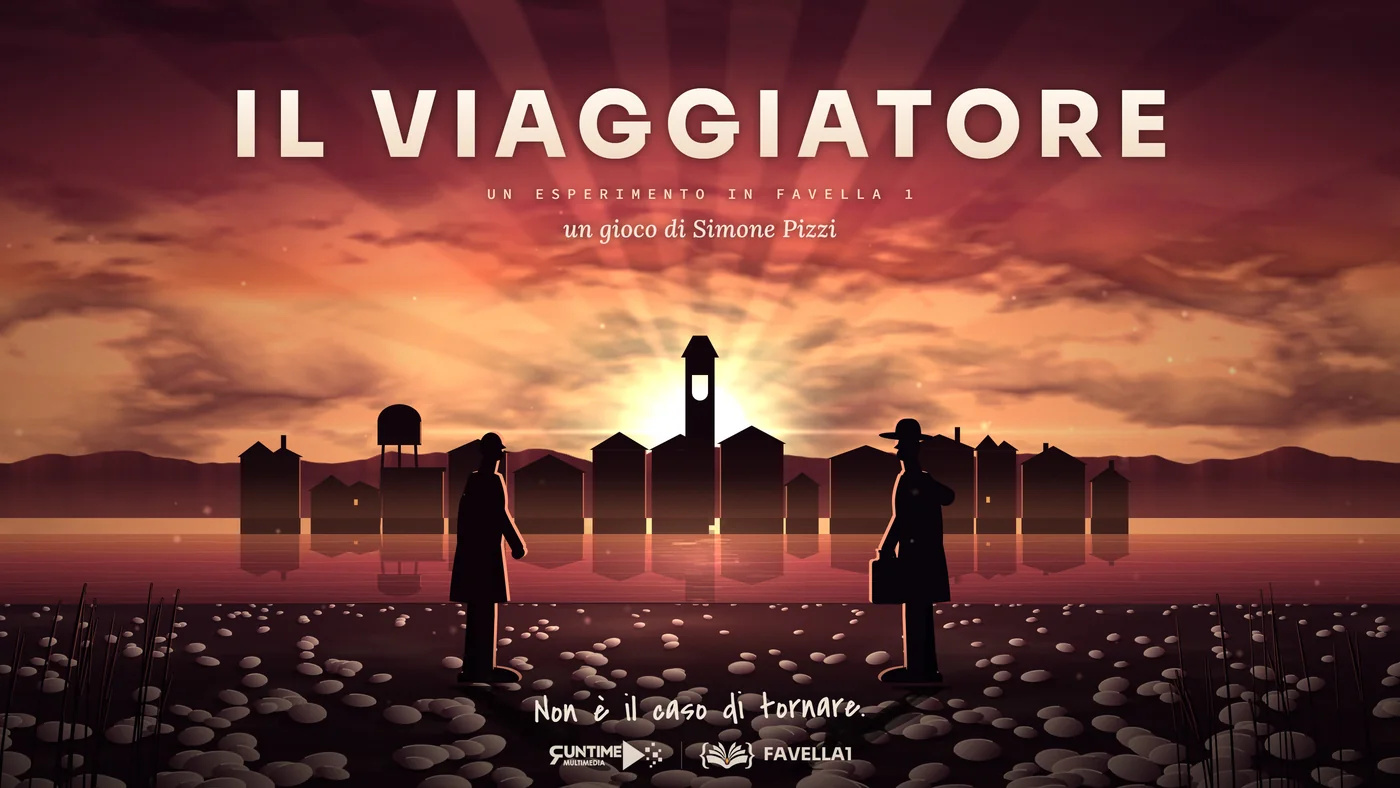
Your wife’s letters have stopped arriving. The last note, in block capitals and unsigned, says only: "There’s no need to come back." You come back anyway.
A man walks home on foot across a south that has run out of water. The journey crosses seven zones and thirty-nine places, with fourteen characters to meet, six story endings and three death endings.
Thirst is the backbone of the story, and water is the currency. Hunger is there too: when the body asks, you answer with the right command, “bevi” for thirst or “mangia” for hunger. Choices weigh, and what you decide in one zone can come back in a later one.
Since 1.19.0 the story has a voice: the game is fully voiced, about an hour of speech, and since 1.41.0 it is voiced in English too. The narrator, the fourteen characters, the hints and even the opening trailer can be heard, sentence by sentence, while you play; anyone using a screen reader can leave the reading to it.
1.41.1, released on 1 November 2026, is the final version: the whole story, voiced in Italian and English, with its trailer, tabbed options, a pause menu, named and quick saves, the trophies, music for every zone with the soundtrack to download, a closing sequence with the end credits and their song, the button board, a physical map of the province on which the journey is drawn, the characters' faces and the plates of the objects of memory. It is a download for Windows and Linux, or you can play it in the browser, with nothing to install, from the game’s page on GitHub Pages.
Features
- 01
Fully voiced in Italian and English: sixteen voices, trailer included
- 02
Play in Italian, typing commands or by clicking, and in English, by clicking
- 03
Thirst and hunger as the backbone of the journey
- 04
Tabbed options, high accessibility, pause menu, named and quick saves (F5/F9)
- 05
Thirty trophies, music for every zone and the soundtrack to download
- 06
The closing sequence, with the end credits and their song
- 07
The button board and a physical map of the province, on which a hand draws the roads you have walked
- 08
The faces of the fourteen characters and the plates of the eight objects of memory
- 09
88-second trailer with an original soundtrack
- 10
1.41.1, the final version: a download for Windows and Linux, or play it in the browser
- 11
Open source: MIT for the code, CC BY-SA 4.0 for story, art, the intro theme and the voices of the narrator and Kira (not the characters' ElevenLabs voices or The Runtimers' music)
Screenshots
01 / 11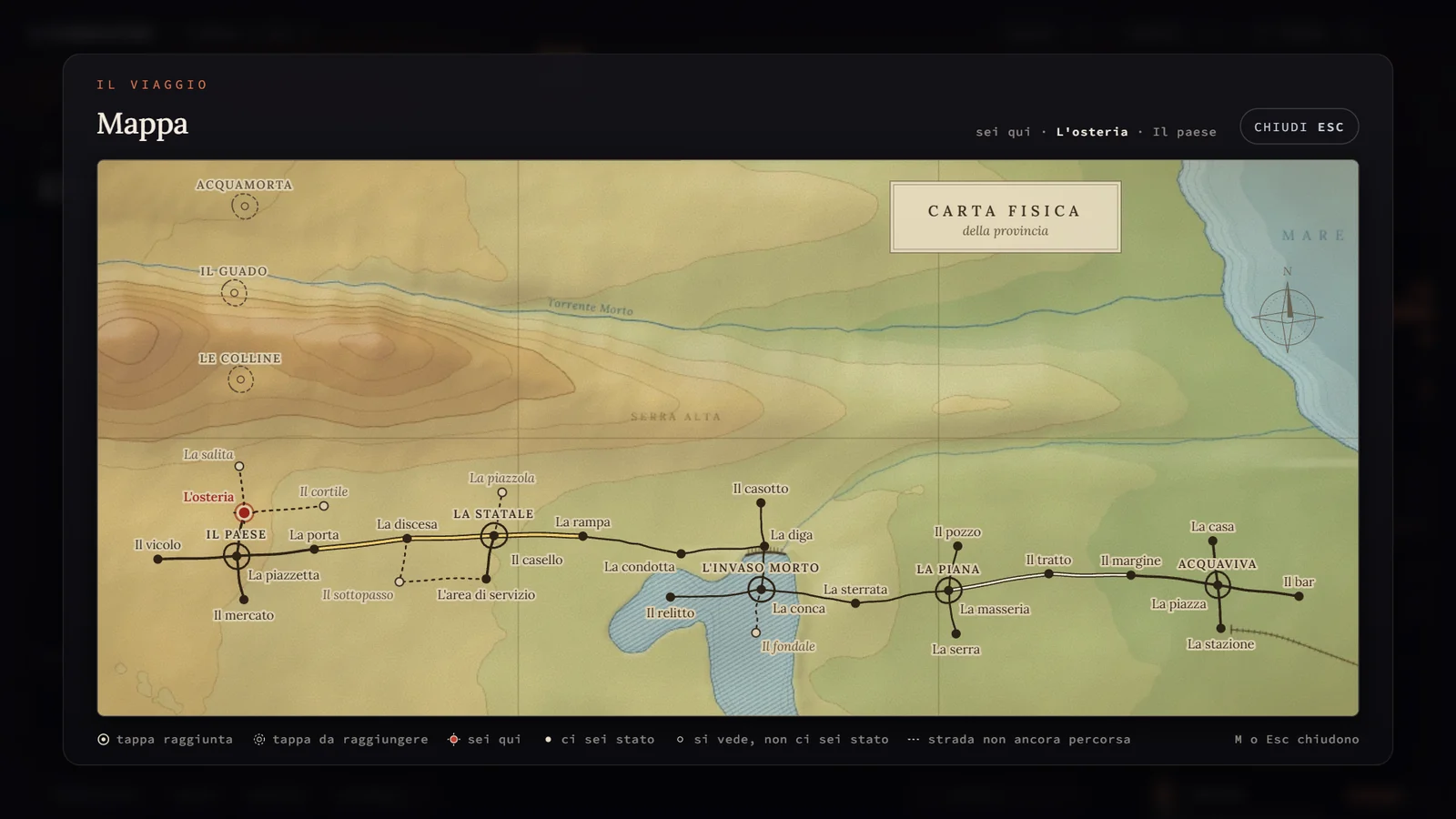
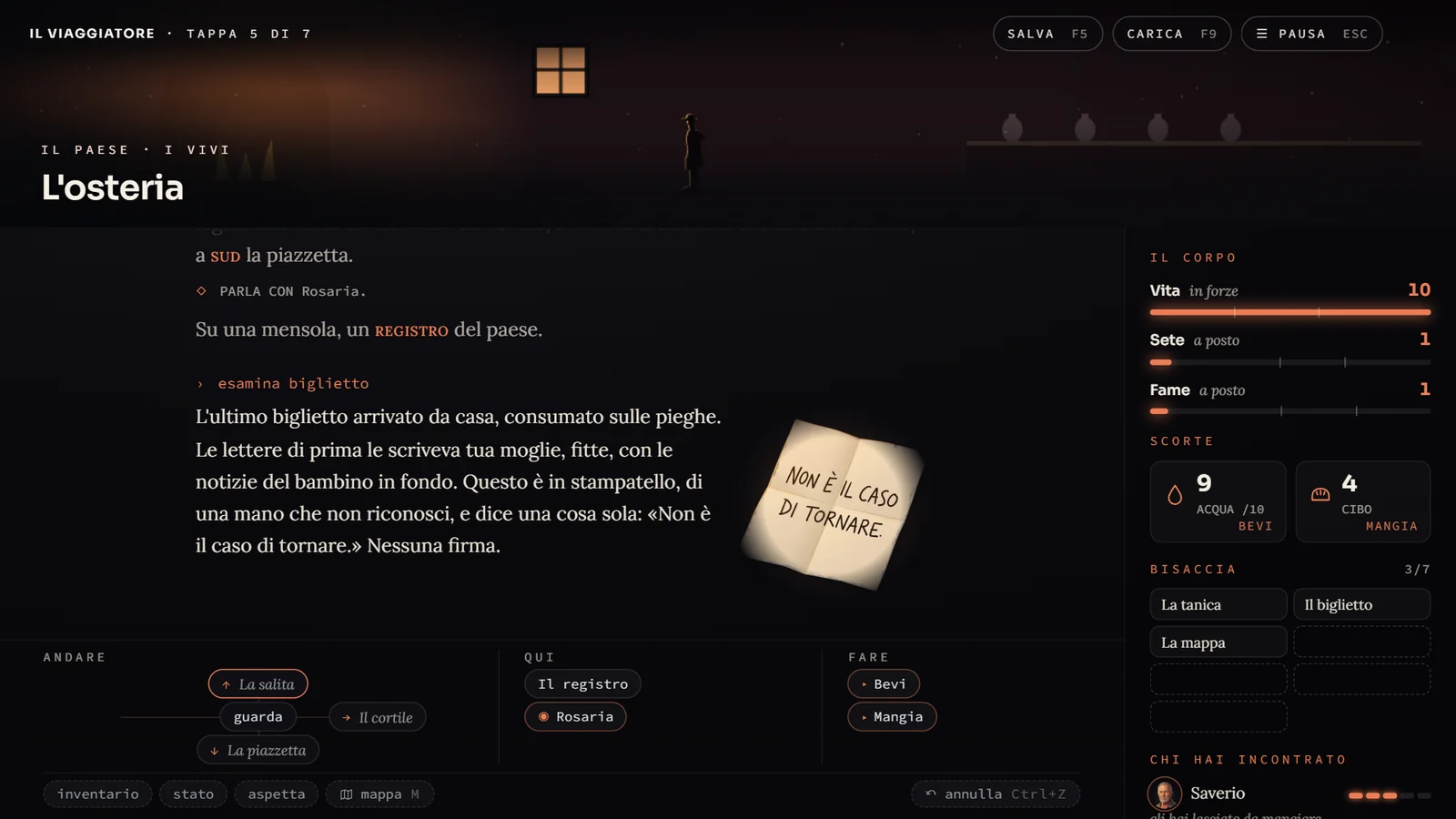
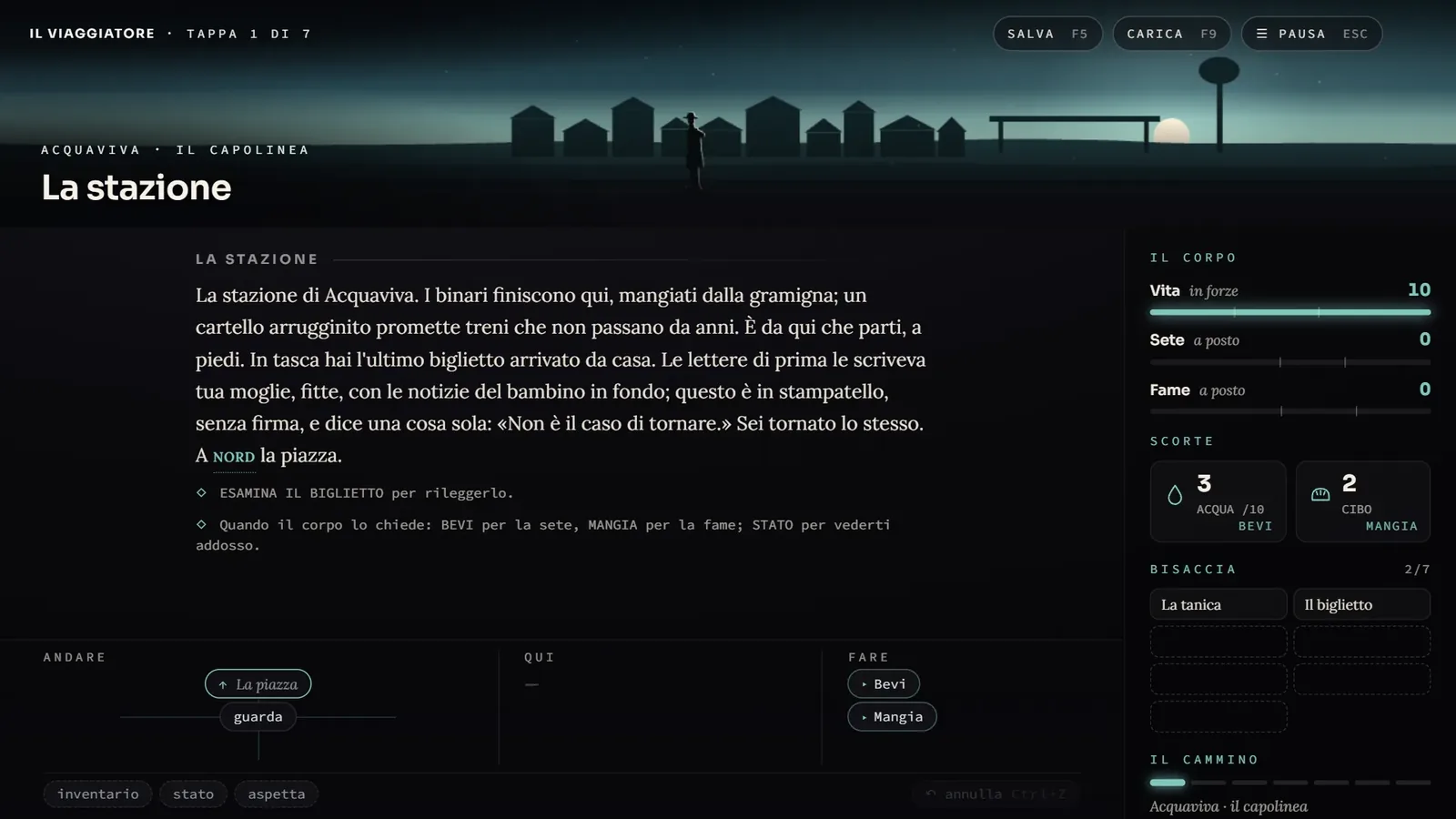
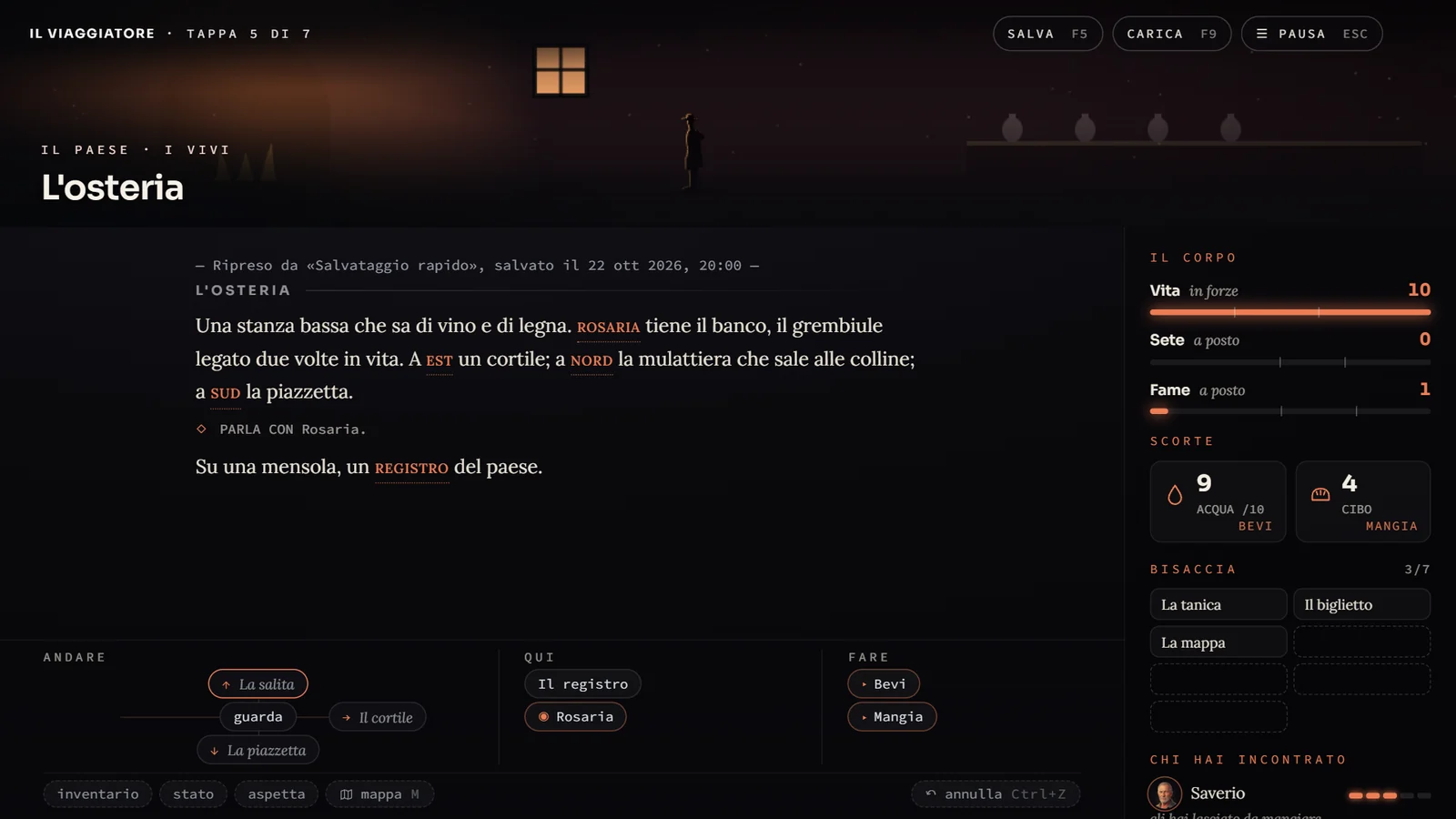
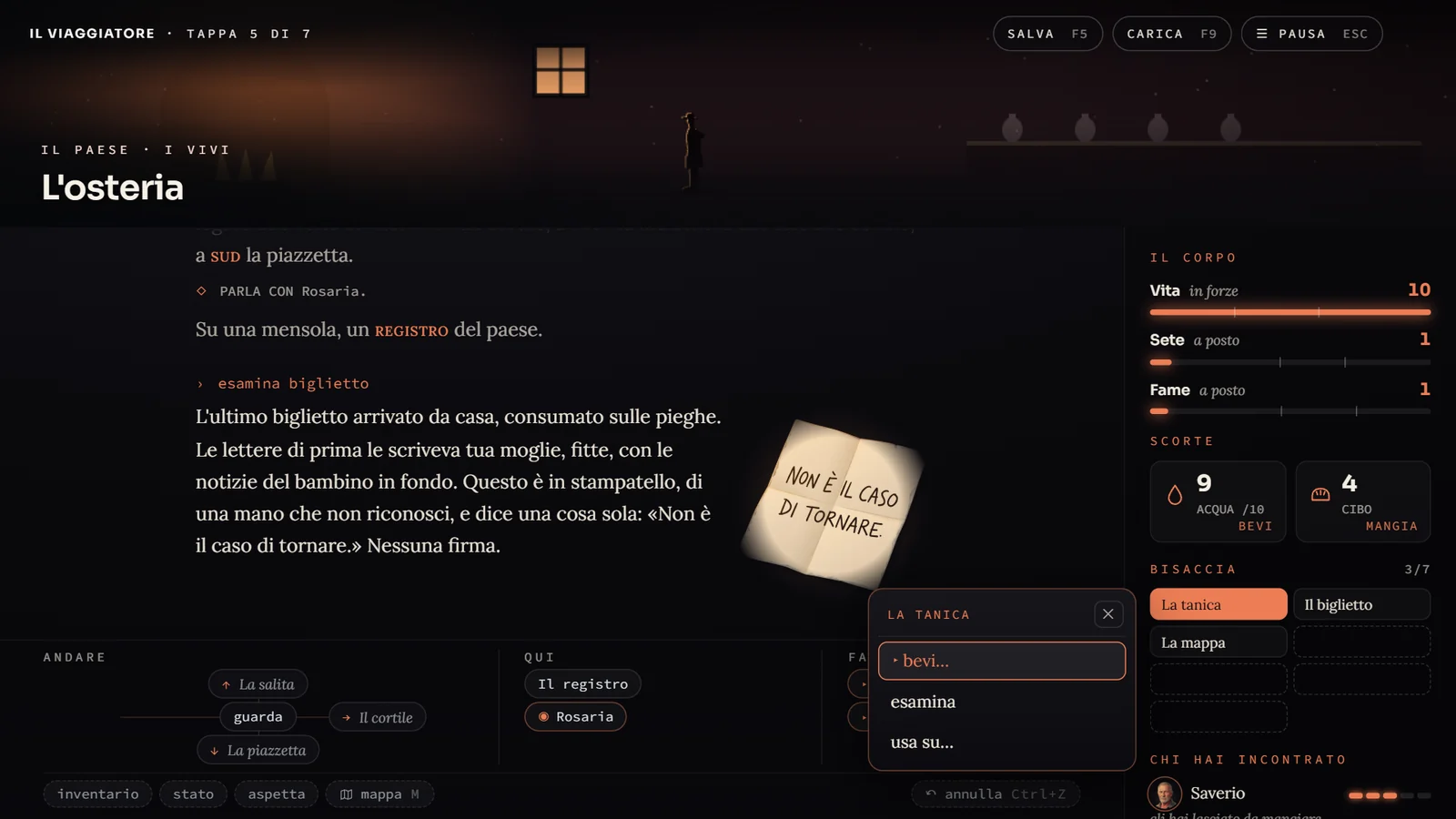
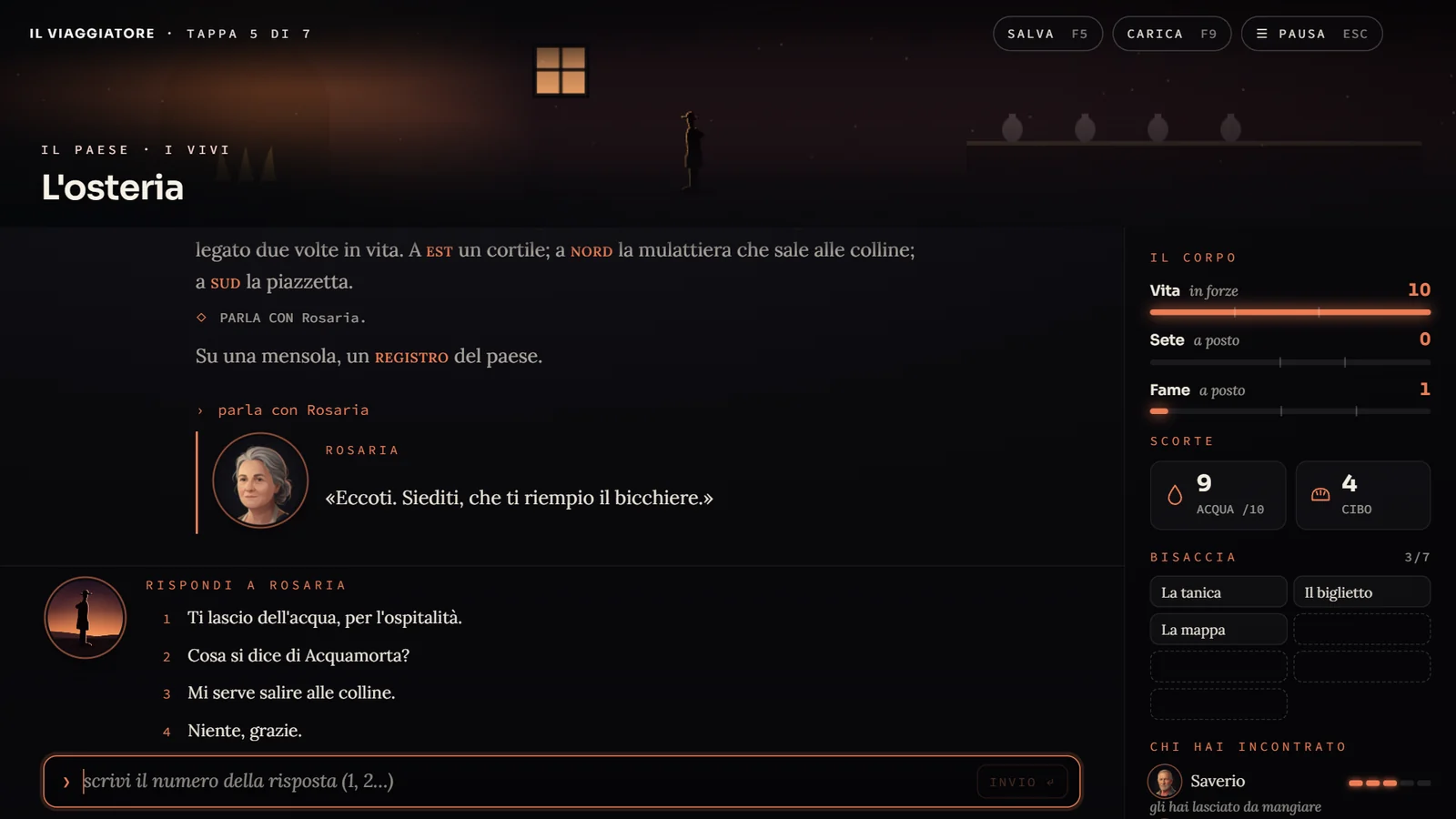
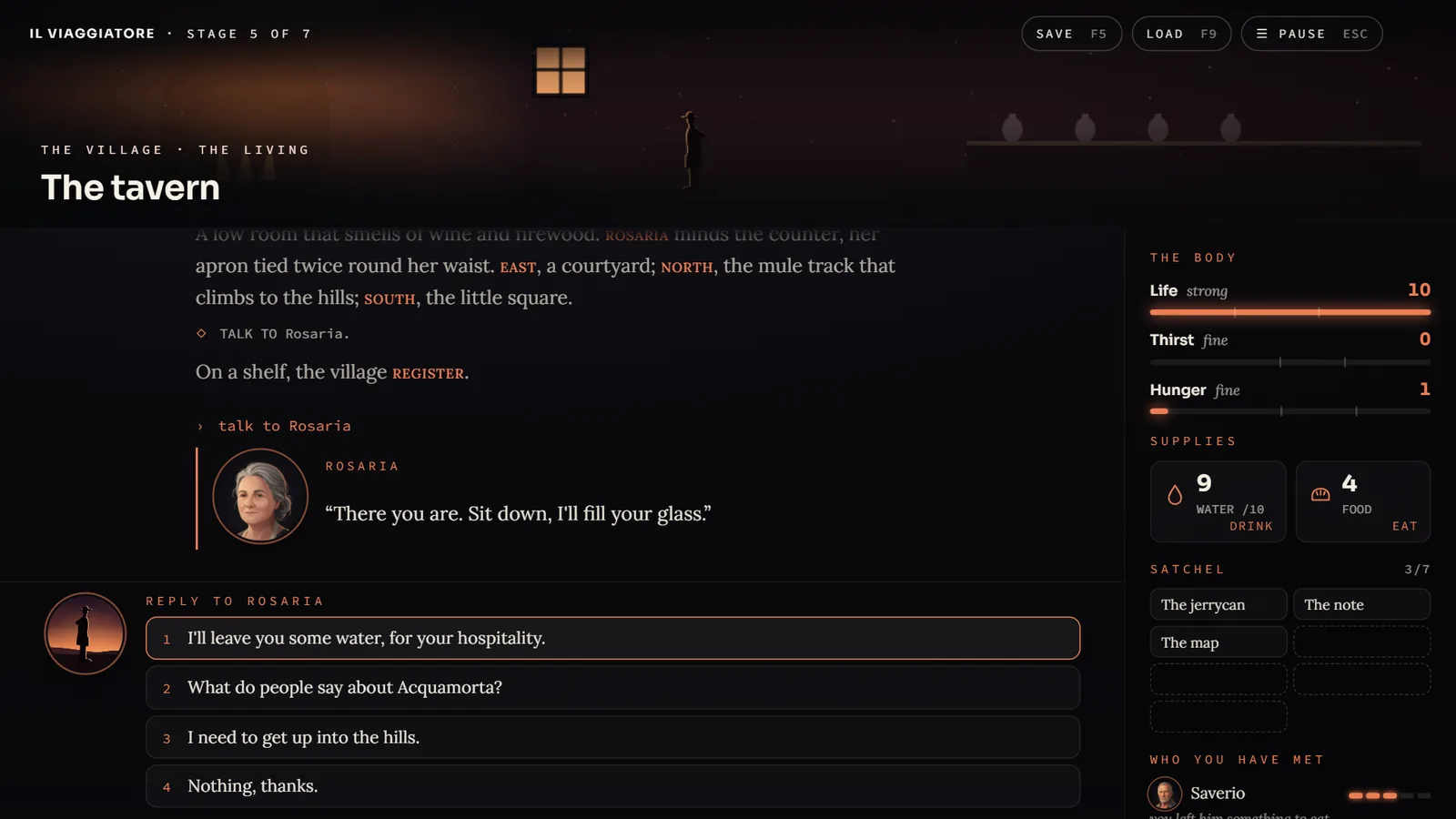
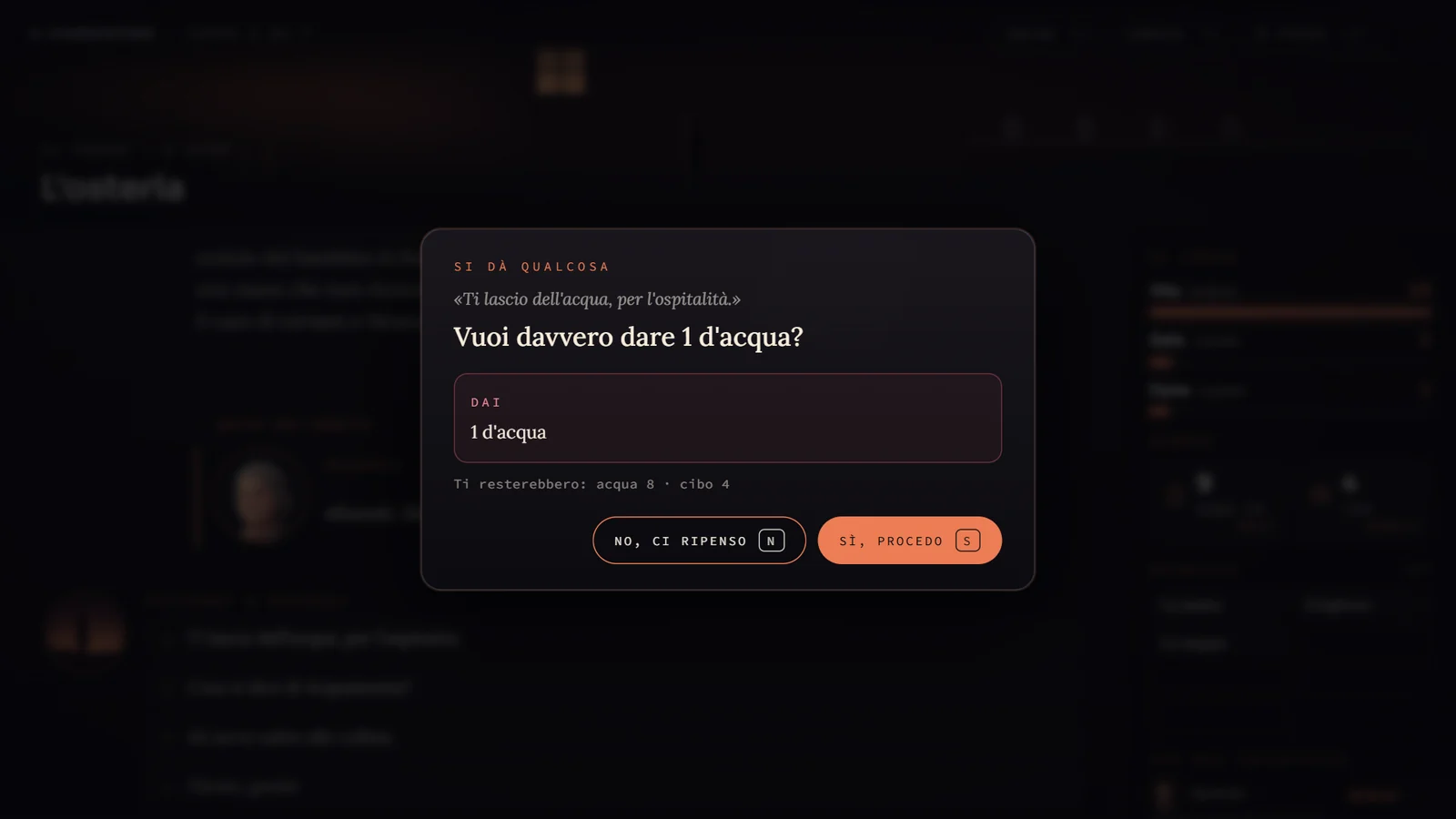
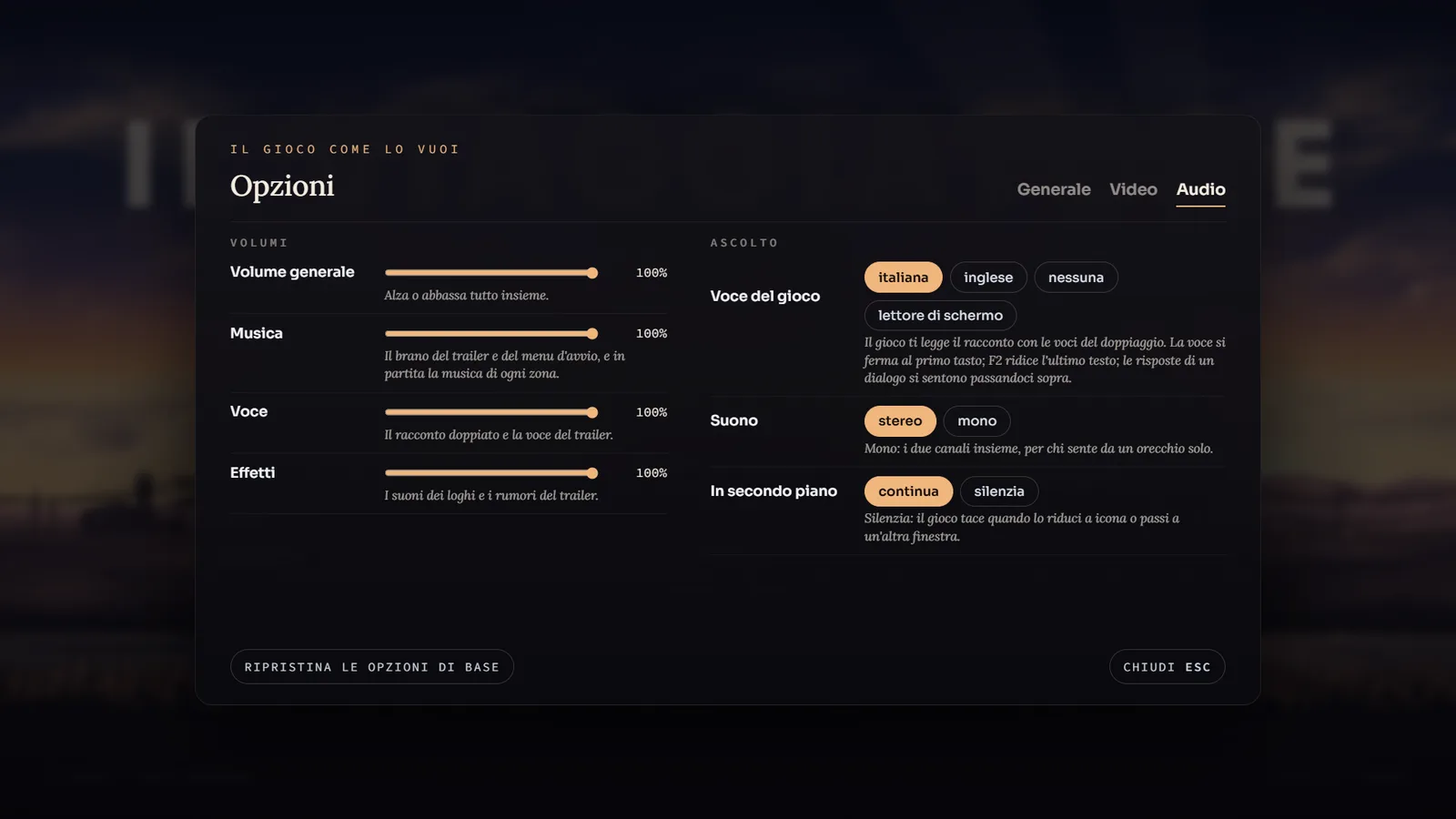
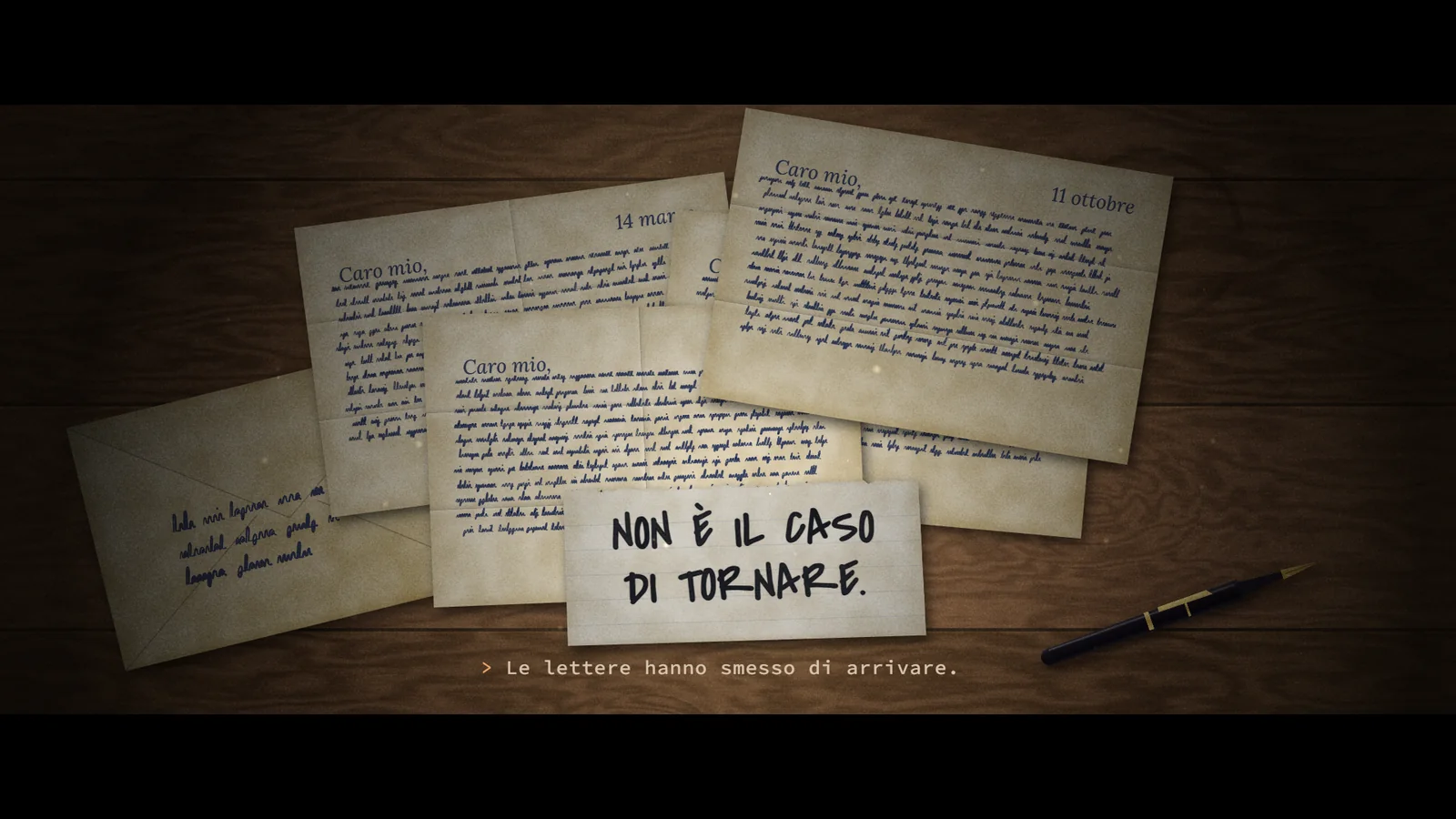
They scroll on their own. Click an image to enlarge it.
How to play
The commands are in Italian, as in classic adventures: «bevi», «parla con Rosaria», «usa la lettera su Cosimo». Or you tap: exits, objects and answers are a click away, and you can play without typing a word.
The game opens with the choice of language (on first launch), then the logos of Runtime Multimedia and FAVELLA 1, animated and with sound, a notice and an 88-second trailer with its original soundtrack and the narrator’s voice. The start menu is a column of entries: continue, new journey, load, trophies, options, how to play, extras, quit.
- Esc
- Skips the logos and the trailer and closes the notice, like Enter. During play it opens the pause menu.
- F2
- Repeats the last text with the dubbing voice.
- F11
- Turns full screen on or off.
- F5 · F9
- F5 quick-saves to a quick slot, F9 loads it back.
- “esci” · Alt+F4
- From the menu, or with the system shortcut, closes the game.
In English
Il Viaggiatore also plays in English: the text arrived in 1.40.0, the voice in 1.41.0. On first launch a window asks for the language of the text, Italian or English, and for the voice: the Italian dubbing or the English one, no voice, or the screen reader. Then everything can be changed from the options, even in the middle of a game.
In English the whole story (about eleven thousand words), the names of places, things and people, the interface, the trailer and the end credits are translated; the title stays «Il Viaggiatore». The FAVELLA engine and story do not change: the game translates the text the engine prints as it shows it, so games, saves and trophies are the same in both languages. In 1.40.1 the translation was reread from top to bottom.
In English everything speaks. The narrator, Enzo, has a British voice and reads the narration, the player’s choices and the trailer: about three quarters of an hour of speech. Kira, the service voice, speaks the hints and the supplies in English too. The fourteen characters perform the same lines as in Italian, with the same tones and the voice they have in Italian.
- Commands
- In English you play with the buttons and the words in the text: the FAVELLA parser understands Italian, and the “text adventure” option comes back in Italian.
- Word by Word
- A trophy for English only, in place of the typed-commands one: reach an ending taking from the text, by touching its word, every way the text names.
The final version
1.41.1, of 1 November 2026, gathers versions 1.24.0 onwards, with the same story and the same texts, and it loads earlier saves. The game is the same on Windows, on Linux and in the browser; the download adds window and full-screen settings in the options, saves as files in the Documents folder and, with the Windows installer and the AppImage, automatic updates. Inside there are:
- Options
- A tabbed panel. Audio: music, voice and effects volumes, the Italian or English voice, no voice or the screen reader, stereo or mono, silence when the game is in the background. Video: the graphics quality and, in the downloaded game, full screen or window, remembered between launches, and the window size. General: the language of the text; commands as buttons or as a text adventure; in the downloaded game, updates; resetting the trophies.
- Accessibility
- A single switch, “alta accessibilità” (high accessibility), turns on high contrast, larger text, the Atkinson Hyperlegible Next typeface, reduced motion and a marked keyboard focus together; then each one can be set on its own.
- Commands
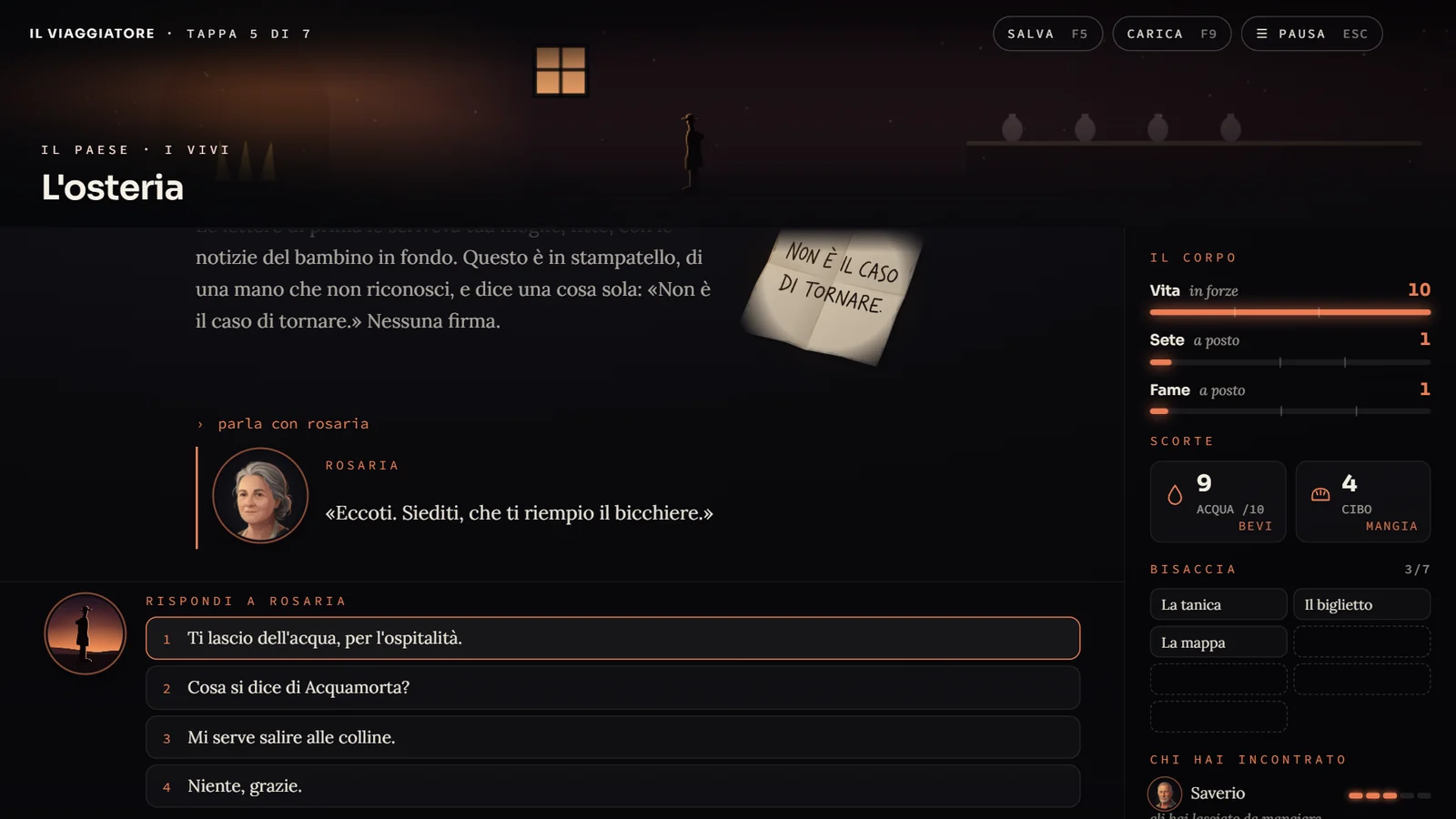
- Two modes, chosen in the options. “Pulsanti” (buttons), the default: you play with the button board, three areas that stay put from place to place: going, with the exits laid out as a compass rose and “guarda” (look) in the middle; here, the people and things of the place; doing, drinking, eating and the actions the place allows. Tap a thing and what you can do with it opens right beside it. “Avventura testuale” (text adventure): every command is typed in Italian.
- Map
- The map found in the house at Acquaviva has its own button, or the M key. It unfolds like a sheet folded in three, with a rustle of paper: it is a physical map of the province printed before the drought, with relief tints, the stream, the sea to the north-east and the reservoir lake still full. Over the print, the hand: the stages are there from the start, the roads are discovered by walking, each drawn in the stroke of its class, from the main road to the paths. Where you are, a red disc with crosshairs; at the reservoir the hand hatches the salt over the lake. It costs no turn; with high contrast it is white paper and black ink, and for anyone who cannot see the sheet a list says the same things.
- Faces and plates
- Whoever speaks has a face, a round cameo beside the line: the fourteen characters, plus Imma after she has eaten and Pasquale healed. The protagonist and his family stay faceless: beside the answers stands the wanderer of the landscapes, in the light of the zone. Examining the photo, the note, the jerrycan, the diary, the wedding ring, the toy horse, the holy card or Cosimo’s letter, its illustration appears beside the text; the crooked photo on the wall straightens when you straighten it. In the text adventure too.
- Pause
- Esc, during play, opens the pause menu: resume, save, load, trophies, options, how to play, start menu, quit.
- Saves
- As many as you like, each with its name, a thumbnail of the landscape, the play time and the point in the journey; F5 quick-saves, F9 reloads; three automatic saves in rotation.
- Trophies
- Thirty, in six families: the endings, the deaths along the road, the gestures towards the people you meet, the ways of arriving, the challenges, the collection. They stay hidden until you win them, with a hint that says where to look, not what to do.
- Music
- A track for each of the seven zones, from The Runtimers' soundtrack: indoors it sounds as if from inside, and it drops when the narrator speaks. From Extra you can download the album “Il Viaggiatore Official Soundtrack”, eight tracks.
- The ending
- After one of the six story endings, the closing sequence: Acquamorta at sunset, the line of the ending, nightfall, the end credits and the song “La mano sa ancora la forma”; then the start menu. From Extra you can watch the trailer and the end credits again.
The voice
Il Viaggiatore is fully voiced with speech synthesis, in Italian and English, with sixteen voices: in Italian it comes to about an hour of speech. The narrator reads the descriptions and the player’s choices, every character has their own voice and a tone for each line, and a service voice speaks the hints and the water and food supplies, assembled number by number. The opening trailer is read by the narrator too, in a narrative and emphatic way, with the music lowered beneath him.
The voice follows the text the engine prints: every sentence on screen finds its recording. It stops at the first key you press, as in a talkie, and the text stays. The answers in a dialogue are read by the narrator when you hover over them with the mouse or reach them with the keyboard.
In the options, Audio tab, you choose between the Italian voice, the English voice, no voice and the screen reader (no game voice: the journal is announced to the reader), and set the volume. With a game voice the screen reader still receives what the voice does not say. The downloaded game works offline.
- Voices
- Google Gemini 3.8 Flash TTS for the narrator (Enzo) and the service voice (Kira), who have British voices in English; ElevenLabs (elevenlabs.io) for the fourteen characters, with the same voice in Italian and English.
- Keys
- Any key stops the voice; F2 repeats the last text; the options set it.
Saves
On the menu, “Continue the journey” resumes the most recent save.
On the desktop the notebook holds as many saves as you like, each with its name, a thumbnail of the landscape, the place, the play time, the body and the supplies; you can load, overwrite, rename, export and delete them. F5 quick-saves to a quick slot, F9 loads it back, and three automatic saves are written in rotation at every change of place and when you leave the game. They are .viaggiatore files in Documenti/Il Viaggiatore/Salvataggi, in readable JSON: you can copy them to another computer, and saves from earlier versions open. In the browser the saves stay in the browser, and you can export them to a file from the notebook.
A save does not snapshot the world. It records the sequence of commands and a SHA-256 fingerprint of the state. On load, the engine replays the game and checks that the state is identical. That is why ANNULLA (undo) still works after a load, and why a save survives updates to the game.
Where to play
- Browser
- 1.41.1, with nothing to install, from the game’s page on GitHub Pages; it works best on a computer, with a recent browser. The first time it downloads the interpreter and the voices (a few dozen MB), then the browser keeps them. With every new release the page puts the updated game back in the browser.
- Windows
- 1.41.1: installer with automatic updates, or the portable version.
- Linux
- 1.41.1: AppImage for any distribution, or .deb for Debian, Ubuntu and Mint.
- Updates
- The installer and the AppImage update themselves from the GitHub releases: the new version downloads quietly and installs when the game closes, or straight away with “riavvia ora” (restart now). The portable version and the .deb update by downloading the next release. The check at startup can be turned off in the options.
- Security
- The executables are not signed, so Windows SmartScreen may ask for confirmation before the game starts (“More info” → “Run anyway”).
- Technical log
- On Windows: %APPDATA%\Il Viaggiatore\logs\viaggiatore.log. On Linux: ~/.config/Il Viaggiatore/logs/viaggiatore.log. Attach it to any bug report, with the version shown at the bottom right of the menu.
The project is finished
The story is the one of 1.12.0, final. Version 1.14.0 brings in the FAVELLA 1.5.0 engine and the opening logos, 1.18.2 refines the trailer frame by frame, and from 1.19.0 to 1.23.0 the game receives its full dubbing. From 1.24.0 onwards the version for Windows and Linux grows, with the options, the pause menu, the saves, the trophies, the zone music, the closing sequence, the button board and the map; 1.38.0 and 1.39.0, of 30 October 2026, bring the physical map of the province, the characters' faces and the plates of the objects of memory; 1.40.0, of 31 October, brings the English text. 1.41.0, of 1 November, gives it a voice, and remakes the Italian character voices with ElevenLabs as well; 1.41.1, the same day, closes the work with the fixes from the code review and Electron 44.10.1. It is the final version. In the browser the game had stayed at 1.23.0: since 1 November the page on GitHub Pages offers it again, always at the latest release. The story and the texts stay the same. Saved games keep working as long as the releases remain on GitHub.
The repository stays open under its licences, for two uses: to study how a long story becomes a game in FAVELLA 1, or to extend it with new zones, characters and endings, or with another story on the same framework.
The game was born as a demo of the FAVELLA 1 programming language and interactive fiction engine. It was made with significant help from language models of the Claude family.
How it is built
The repository holds the adventure, the engine that runs it and the automated tests. The main folders:
- prototipo/
- The adventure: the main file and the seven zones, written in FAVELLA 1.
- motore/
- The FAVELLA 1.5.0 engine, in Python: it runs inside the game on Pyodide, with no server and no network.
- app/
- The interface: the logos, the trailer, the game, the “how to play” guide, the closing sequence with the end credits, the English translation and the dubbing voice, one file per sentence.
- doppiaggio/
- The dubbing: the texts for the voices taken from the story, the parts, the chosen voices.
- desktop/
- The Electron shell for Windows and Linux.
- pagine/
- The game’s page on GitHub Pages, in Italian and English: at every release it picks up the new downloads and puts the updated game back in the browser.
- grafica/
- The icon, the README cover and the promotional images: the key art in six formats.
- collaudo/
- The sixteen automated tests: one game for each of the nine endings, the situations that must not break, the saves, the buttons, the map, the dubbing voice, the English translation, the trophies, the music and a hundred random games.
Licences and credits
The same information is in the game (in the end credits) and in the repository.
- Story, texts, intro music, art
- CC BY-SA 4.0, © Simone Pizzi (Pitz72). The Gemini voices of the narrator and of Kira and the promotional images too.
- Portraits and object plates
- Generated with Google’s Nano Banana Pro 2.1, in Google Flow, and distributed under the content licence, CC BY-SA 4.0; they are in the end credits.
- Code and engine
- MIT. The engine is FAVELLA 1.
- Zone music, end-credits song
- By The Runtimers, generated with Google’s Lyria 3.5, like the album “Il Viaggiatore Official Soundtrack”: outside the free licence, under Google’s terms for content generated with Lyria. They are redistributed as part of the game; a derivative work without the rights to them must remove them.
- The voices of the fourteen characters
- ElevenLabs voices (elevenlabs.io), in Italian and English, outside the free licence and for non-commercial use only: a derivative work or a commercial use must remove or replace them.
- Components
- Pyodide (MPL-2.0); Lark, React, Electron, electron-updater (MIT); Inter, Lora, Sora, Source Code Pro, Covered By Your Grace and Atkinson Hyperlegible Next fonts (SIL OFL 1.1).
- Trademarks
- The Runtime Multimedia and FAVELLA 1 logos belong to their respective owners, in the promotional images too: anyone reusing those images for something else must remove them.
Technical sheet
- Version
- 1.41.1, final (Windows, Linux and browser)
- License
- MIT for the code, CC BY-SA 4.0 for story, texts, intro theme, the voices of the narrator and Kira, art, portraits and plates; the ElevenLabs voices of the fourteen characters for non-commercial use only; The Runtimers' music outside the free licence
- Platforms
- Windows · Linux · browser
- Engine
- FAVELLA 1.5.0 (Python), on Pyodide inside the game
- Languages
- Italian · English (the text from 1.40.0, the voice from 1.41.0)
- Voice
- Full dubbing in Italian and English, 16 voices (Google Gemini 3.8 Flash TTS, ElevenLabs)
- Music
- The intro theme, a track per zone and the end-credits song (The Runtimers, Lyria 3.5)
- Author
- Simone Pizzi (Pitz72)
- Development
- Concluded: 1.41.1 is the final version
- Status
- Available
Available
Ready to try it?
Get it from the releases page, with the source open.
Other versions: Windows portable · Linux .deb

Universo Favella
In Universo Favella
FAVELLA is the programming language in Italian for interactive fiction. These pages are part of the same world.
 Universo Favella
FAVELLA 1
An interactive fiction engine you program in Italian.
Discover → Universo Favella
Favella Studio
Write your adventure, watch it become a world.
Discover → Universo Favella
FAVELLA 1: Manuale di Programmazione
Write a story. Get a world.
Discover → Universo Favella
Favella Studio: Guida all’uso
The step-by-step guide to Favella Studio, the writing environment of FAVELLA 1.
Discover → Universo Favella
Il Relitto Silente
An alien wreck on the Santa Maria’s course. Inside, a ship that was grown rather than built.
Discover →